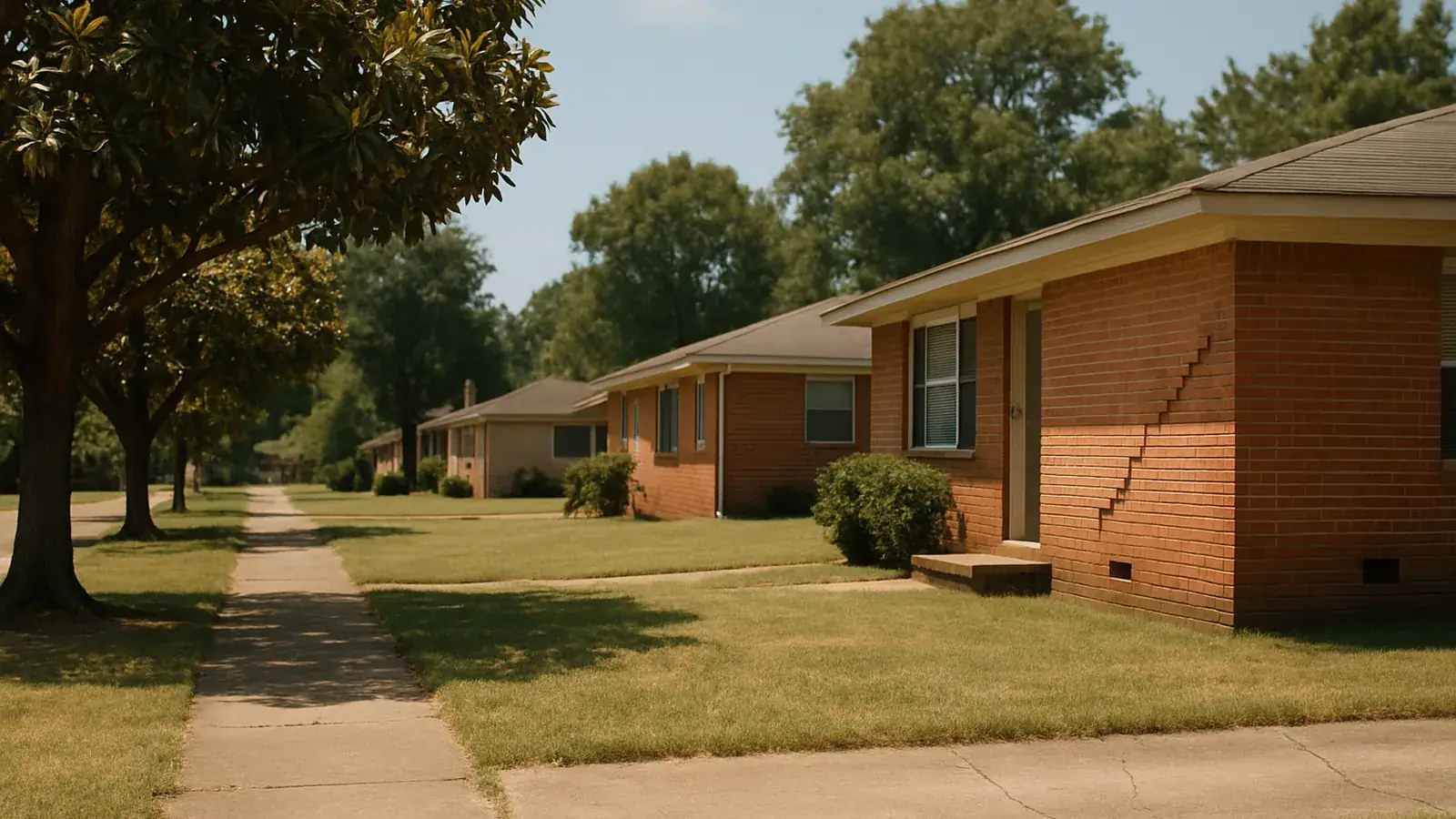
Yazoo clay is the short answer to most Jackson foundation questions, and the long answers are below: what the Jackson Group belt does through a wet-dry year, how to tell finished movement from active, and what a repair should include.
How do I know if I have a problem?
Doors that stick in one season and swing free in another, a crack that keeps reappearing after it is filled, floors that feel out of level near one wall. These are the things people notice first, and they are worth understanding before they are worth worrying about.
Why do Jackson foundations move?
Yazoo Formation clay - central Mississippi Vertisols ranking among the highest on the national shrink-swell index, changing 15-30% in volume between wet and dry. Drought pulls the clay away from the slab perimeter and the concrete settles into the void it leaves.
Do I need piers, or just drainage?
The elevation survey answers it. A house reading near flat with cracks that have not changed through a full cycle needs water managed and monitoring. A house reading an inch or more low in a defined zone needs piers there. A meaningful share of houses here need drainage only.
Should I water my foundation?
On this clay, yes. Consistent perimeter moisture through drought keeps the soil from shrinking away from the slab edge. Soaker hoses two to three feet out, run modestly on a timer rather than heavily and occasionally, are the cheapest foundation protection in central Mississippi.
What does foundation repair cost in Jackson, and why do quotes differ?
What a repair costs here depends on how much of the foundation moved and how deep the piers have to go, which is why two honest quotes can differ.
How much does foundation repair cost in Jackson?
Most full repairs run $4,000-$15,000, piers $1,200-$3,000 each, slab work $3,500-$12,000, drainage correction $1,500-$6,000, and crack repair $400-$1,500. The elevation survey decides which applies; many local specialists don't charge for it, so ask when they call.
Does insurance cover foundation repair in Mississippi?
Rarely for soil movement - policies exclude earth movement, which is what Yazoo clay swelling is. Frequently for damage caused by a sudden plumbing discharge under the slab, which is common here. A static plumbing test before piering either finds a covered cause or rules one out.
What happens if I go ahead?
What actually happens once you say yes: timings, paperwork, and what carries over if you sell.
Which cracks actually matter?
Width, direction, and change - not length. Hairline vertical cracks are usually shrinkage. Stair-step cracks through brick mortar, horizontal cracks, anything wider than a quarter inch, and anything growing month over month indicate movement and deserve a survey before sealing.
How long does the work take?
Two to five days for most pier jobs, with nearly everyone staying in the house. Drainage corrections are frequently a single day. Concrete leveling is hours. Ask for the timeline in the written scope before anything starts.
Is there a warranty?
On pier work, ask for one in writing, and read it before the price. Most cover the piered section holding its design load, not the whole house. Ask whether it transfers to the next owner, what a transfer costs, whether it is third-party backed, and whether it depends on drainage maintenance you owe.
Still have a question?
Call (any time) or book the evaluation. Every job class is priced in the cost guide.
Get a Jackson foundation evaluation
Tell us what the house is doing (stair-step cracks, doors that stick every August, sloping floors, separating trim) so the evaluation starts from what you have seen. A local specialist who works in Jackson will call you back.